

KEY TAKEAWAYS
- The DuPont schedule is a 12-hour, four-crew, 28-day rotating shift pattern that delivers 24/7 coverage while giving employees a full seven-day break every four weeks.
- Average hours are 42 per week, but one week of every cycle requires 72 hours, often called "hell week." This is the schedule's single biggest workforce risk.
- It is most common in continuous-process manufacturing, oil and gas, nuclear power, chemical plants, mining, emergency services, and transportation.
- Three proven modifications (an 8-hour training shift, shorter Thursday shifts, or adding a 5th crew) address the hell-week fatigue, management continuity gap, and absence pinch points.
- The schedule only works when it fits the site. Employee-selected schedules consistently outperform management-mandated ones across Circadian's 40 years of shift scheduling work.
The DuPont Schedule is a popular shift schedule for 24/7 operations, originally developed in the 1950s by employees at the DuPont Company.
This schedule is built around a 12-hour shift structure for 4 rotating crews and is known for offering a coveted 7-day break once every four weeks.
In this guide, we'll cover:
- The structure of the classic DuPont Schedule.
- The pros and cons of this schedule.
- Modified versions of the DuPont Schedule.
- How to determine if it's a good fit for your operation.
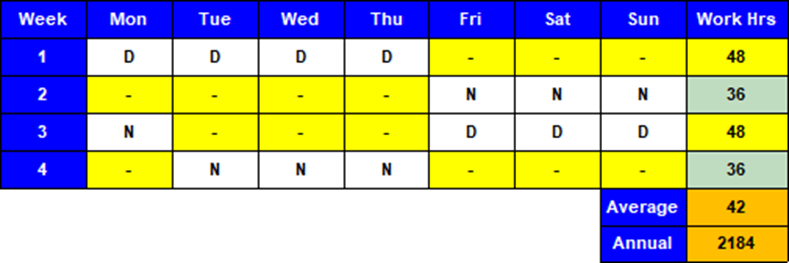
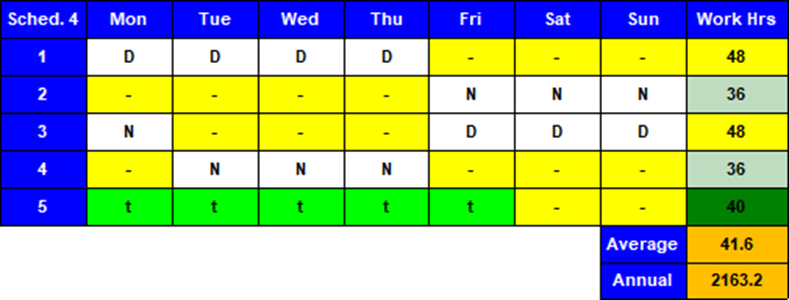
Across any 28-day cycle, each crew works:
- 4 consecutive night shifts, followed by 3 days off
- 3 consecutive day shifts, followed by 1 day off
- 3 consecutive night shifts, followed by 3 days off
- 4 consecutive day shifts, followed by 7 consecutive days off
This produces 14 shifts (168 hours) per crew per cycle, four crew rotations per month, and one long break. Each day, two of the four crews are on shift, which is what keeps the operation running continuously. This rotating pattern ensures 24/7 coverage while providing employees with a recurring long break.
What industries use the DuPont schedule?
The DuPont schedule is best suited to continuous, capital-intensive operations where stopping production is costly, where a stable crew structure matters more than shift flexibility, and where the workforce can tolerate long shifts safely. In practice, it is most commonly used in:
Where the DuPont schedule fits poorly: customer-facing operations with uneven demand, retail, call centers with predictable daytime peaks, and any environment where 12-hour cognitive or physical loads exceed what workers can sustain safely. In those settings, Circadian typically recommends 8-hour variants or hybrid structures. For background, see our comparison of 8-hour vs. 12-hour shifts.
Free Expert Consultation
Not sure if the DuPont schedule is right for your operation?
Talk to a CIRCADIAN scheduling expert about your site, your workforce, and the tradeoffs that matter for your operation. No obligation, no sales pitch. Just 15 minutes with someone who has helped half the Fortune 500 get this decision right.
Book a Free 15-Minute ConsultationTrusted by half the Fortune 500 • 40+ years of shift scheduling expertise
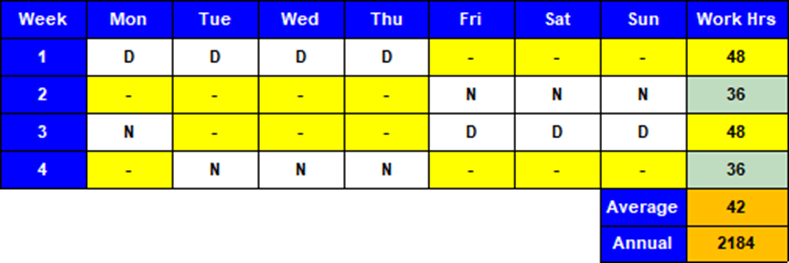
- 7-Day Breaks: Employees enjoy a full week off every four weeks, offering a "mini-vacation" to recharge.
- Consistent Paychecks: The alternating 36- and 48-hour weeks make bi-weekly paychecks predictable.
- More Long Weekends: The schedule provides 26 full weekends off-duty each year, all with at least three consecutive days off.
- Minimizes Circadian Transitions: While the Dupont Schedule is technically fast-rotating (change from days and nights between each work block), crews only transition between day and night shifts four times per cycle, minimizing the impact of industrial jetlag.
- Compressed Work Periods: The Dupont Schedule compresses 28 days of shifts (14 shifts) into 21 days in order to provide 7 days off. One consequence is that employees face a demanding stretch in Week 3, often referred to as "hell week," with six 12-hour shifts in seven days.
- Management Continuity Gaps: Crews may go up to 14 days without direct contact with daytime management, which can be problematic in rapidly changing environments.
- Absence Coverage: The schedule's structure creates "pinch points" where covering absences can be challenging without relief staff.
For example:
- Mondays: Crews 2 and 4 can cover a day or a night shift on Mondays. For Crew 2 this would occur in the middle of their 7-day break, for Crew 4 this would create 7 shifts in a row.
- Tuesdays: The day shift can ONLY be covered by Crew 2 - again interrupting their 7-day break.
- Note: Some managers overseeing the DuPont schedule have mentioned that getting employees to work overtime shifts during the 7-day break can be challenging.
Real-World Result
In one of Circadian's engagements with a major 24/7 operation, replacing a legacy 8-hour rotating schedule with a 5-crew, 12-hour schedule featuring a long break in every 28-day cycle delivered $2.25 million in annual payroll savings, a 16% productivity improvement, twice as many weekends off, and dramatically lower cumulative sleep deprivation. The new schedule was self-selected by employees and ratified by the union.
You can achieve these results in your operation too.
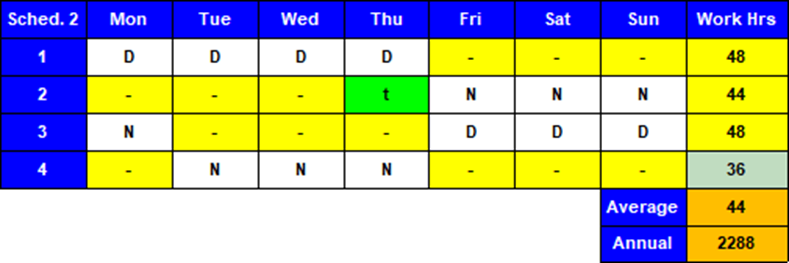
Talk to a Circadian ExpertDupont Schedule Modification 1: Adding an 8-Hour Training Shift:
Incorporating a short training day (e.g., Thursday during the long break) helps maintain management continuity.
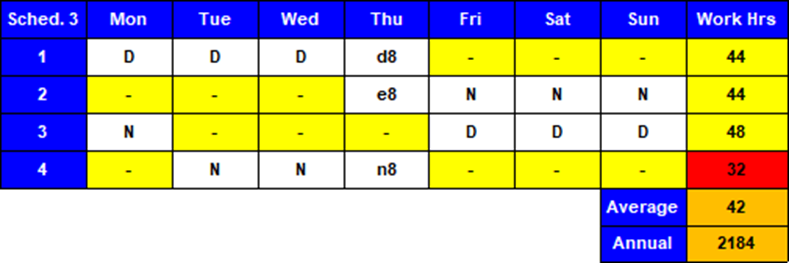
Dupont Schedule Modification 2: Scheduling 8-Hour Shifts on Thursdays:
Scheduling 8-hour shifts instead of 12 hours can ease the workload and provide more interaction with management.
Dupont Schedule Modification 3: Adding a 5th Crew:
A fifth crew can provide relief for absences and handle training without disrupting the core schedule.
Does the DuPont schedule allow for overtime?
Yes, and the overtime exposure is structural rather than accidental. The DuPont cycle averages 42 hours per week, 2 hours above the standard 40-hour FLSA threshold, and one week out of four requires 72 hours. Here is the week-by-week breakdown under U.S. federal FLSA rules:
That is 48 overtime hours per crew per 28-day cycle under federal rules, not counting state-level daily overtime thresholds. Several states impose stricter tests:
- California: Daily overtime after 8 hours (1.5x), double time after 12 hours in a single shift.
- Colorado: Daily overtime after 12 hours.
- Alaska and Nevada: Overtime after 8 hours per day or 40 hours per week.
For unionized and regulated industries, collective-bargaining agreements and industry-specific rules (API RP 755 for refining, PHMSA for pipelines, FRA hours-of-service for railroads) can tighten these limits further. See Circadian's overview of hours-of-service compliance challenges for how scheduling decisions intersect with regulatory exposure.
What are the best alternatives to the DuPont schedule?
If the DuPont schedule's seven-day break and 72-hour week do not fit your operation, four alternatives cover most 24/7 scheduling requirements:
For a deeper comparison, see Circadian's guides to the best shift work schedule and employee-selected vs. management-mandated schedules. Organizations considering expansion from 5-day to 7-day operations should review Circadian's framework for expanding to seven-day operations.
The DuPont Schedule offers many employee-friendly benefits, like long breaks and predictable paychecks, while meeting hours-of-service (HoS) limits in many industries (e.g. RP 755, PHMSA, etc.). However, its success depends on your specific operational needs.
This schedule works best in stable environments where:
- Long breaks don't disrupt workflows.
- Absence coverage can be planned effectively.
Like all shift schedules, the DuPont Schedule has pros and cons. If your workforce likes a rotating schedule and long breaks, this schedule might be a good fit. However, if your people value fixed shifts and not compressing all work shifts into 21 days it may be a poor fit.
Ultimately, the best schedules are site-specific. You need to balance employee preferences with operational requirements, and safety considerations.
Need help evaluating an alternative shift schedule?
Circadian has helped hundreds of 24/7 operations, including half the Fortune 500, select and implement schedules that work for both management and employees through our Shift Schedule Optimization service.
Book a Free 15-Minute Consultation
Frequently asked questions
How many hours per week do you work on a DuPont schedule? −
On average, 42 hours per week over a 28-day cycle. However, the hours per week vary significantly: 48 hours in weeks 1 and 3, 72 hours in week 2, and 0 hours in week 4.
Why is it called the DuPont schedule? +
The schedule was developed inside the DuPont chemical company in the 1950s to solve the coverage and fatigue problems created by their then-standard 8-hour shift structure. Employees inside DuPont designed the rotation, and it spread through the chemical industry before being adopted across manufacturing, nuclear power, mining, and emergency services.
Is the DuPont schedule legal under U.S. labor law? +
Yes, at the federal level. However, FLSA triggers overtime pay after 40 hours per week, and the DuPont schedule generates approximately 48 overtime hours per 28-day cycle per crew. Several states (California, Colorado, Alaska, Nevada) also impose daily overtime thresholds that apply. Operations in regulated industries (oil and gas, nuclear, pipeline, rail, trucking, aviation) must also comply with industry-specific hours-of-service rules.
What is "hell week" in the DuPont schedule? +
"Hell week" refers to the third week of the 28-day cycle, where employees work six 12-hour shifts in seven days, totaling 72 hours. It is the schedule's most cited downside and the most frequent trigger for adopting one of the three standard modifications.
How does the DuPont schedule compare to the Pitman (2-2-3) schedule? +
Both use 12-hour shifts and four crews, but the cycle length differs: DuPont runs on a 28-day cycle with one seven-day break, while Pitman runs on a 14-day cycle with alternating weekends off. Pitman produces more frequent but shorter breaks and avoids the 72-hour hell week. DuPont produces fewer but longer breaks. The right choice depends on whether your workforce prefers occasional long vacations or more frequent shorter ones.
Can the DuPont schedule be modified for a 5-crew operation? +
Yes. Adding a fifth crew is one of the three standard DuPont modifications, and it is particularly effective in large operations where absence coverage and overtime control are chronic problems. A 5-crew variant typically produces longer breaks, lower overtime, and better fatigue outcomes than the classic 4-crew structure, at the cost of higher headcount.
Is the DuPont schedule healthy for workers? +
Rotating 12-hour schedules carry known fatigue, sleep, and health risks. That said, slow-rotating 12-hour schedules with long breaks have been shown to be more biocompatible than fast-rotating 8-hour schedules for many worker populations. Outcomes depend heavily on shift rotation direction, workplace conditions, employee support programs, and lifestyle training. See Circadian's research on shift work sleep disorder and fatigue risk management.
What should we do if the DuPont schedule is not working? +
Do not revert blindly. Document the specific problems (fatigue incidents, turnover, absence patterns, management complaints), survey employees, and compare outcomes against known alternatives. Circadian's Shift Schedule Risk Assessment is designed for exactly this diagnosis.
Can't find the answers you are looking for? We are here to help.
Get in touch






Interested in Shiftwork, Scheduling & Fatigue Risk Management Best Practices?
Subscribe to CIRCADIAN's email list for cutting-edge information, updated research findings, and easy-to-implement strategies, all tailored to optimize the health, safety, and performance of your shiftwork and extended hours operations.
Join our community of 32,000+ industry leaders and receive practical tips and expert insights to optimize your 24/7 workforce.