

Fewer hours per worker. Same production demands. The math doesn't add up - unless you plan ahead.
Mexico's shift to a 40-hour workweek is one of the most significant labor changes in decades - and for 24/7 operations, it fundamentally changes the economics of how work gets done.
On March 3, 2026, Mexico enacted a constitutional amendment to gradually reduce the standard workweek from 48 hours to 40 hours. The reform will be implemented over four years, with the maximum weekly work limit decreasing by two hours annually beginning in 2027, until reaching 40 hours by 2030.
The reform is intended to reduce fatigue, improve safety, and enhance work–life balance. However, for organizations operating continuous or extended-hour schedules - such as manufacturing, energy, mining, and logistics - this change represents a fundamental shift in how operations must be staffed, scheduled, and sustained.
Importantly, the reduction in working hours cannot result in reduced employee pay or benefits, creating immediate implications for labor cost, staffing, and productivity.
What Is Changing in Mexico and Why It Matters
Current State (Today - 2026)
- Legal maximum workweek: 48 hours/week
- Common schedule structure:
- 6 days × 8 hours (48h)
- 1 mandatory rest day per week
- Overtime:
- Up to 9 hours/week at double pay
- Beyond that → triple pay
- Many 24/7 operations:
- Regularly rely on overtime and extended shifts
- Often exceed 48 hours/week in practice
Future State (By 2030)
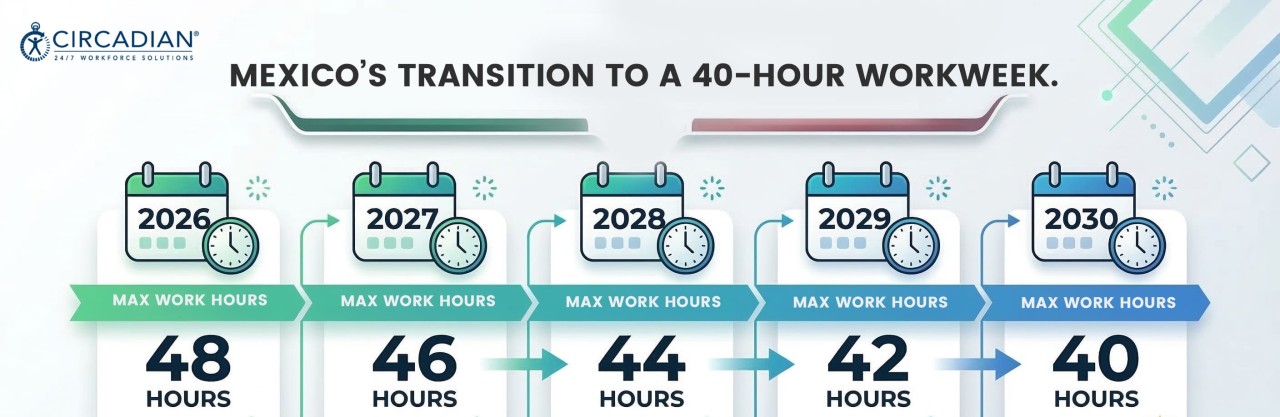
- 2026: 48 hours
- 2027: 46 hours
- 2028: 44 hours
- 2029: 42 hours
- 2030: 40 hours
While gradual, this change introduces a structural challenge:
How do you maintain 24/7 production with fewer working hours per employee - without increasing cost, risk, or workforce strain?
For continuous operations, this is not simply a compliance issue - it is a strategic operational and workforce challenge.
As the standard workweek decreases, overtime will begin sooner and occur more frequently.
1. When does overtime start?
- Today: after 48 hours
- By 2030: after 40 hours
2. How is overtime paid?
Mexico maintains a tiered overtime structure:
- Double-time (2x pay)
Applies to the first block of overtime
→ Typically up to ~12 hours per week - Triple-time (3x pay)
Applies beyond that threshold
→ Typically hours exceeding ~12 overtime hours per week
3. Practical Example (2030 End State)
If an employee works 56 hours in a pay-week (e.g., 7-days x 8-hours):
- 40 hours → regular pay
- 12 hours → double-time
- 4 hours → triple-time
4. QUESTION: Is it illegal to work more than 40 hours in Mexico?
No, but it is strictly regulated and increasingly costly.
Constraints include:
- Overtime must be voluntary
- Typically limited to ~4 hours per day
- Total working time generally capped around 12 hours/day
Key Takeaway
The reform does not eliminate long workweeks… it makes them more expensive, more regulated, and harder to sustain.
5. Implications for Shiftwork Operations in Mexico
This reform disproportionately impacts continuous and extended-hour industries, including:
- Manufacturing (food, automotive, consumer goods)
- Energy (oil, gas, utilities)
- Mining & metals
- Transportation & logistics
These industries share one constraint:
They cannot reduce operating hours (168 hours/week) - only how work is distributed.
1. Structural Staffing Gap
Reducing the standard workweek from 48 → 40 hours creates a fundamental tradeoff:
- ~17% fewer working hours per employee
- Or ~17% (or more) increase in direct labor cost if hours are maintained through overtime
However:
- Production requirements remain constant
Result:
Organizations must address critical staffing levels through one (or a combination) of the following: |
- Adding additional crews
- Increasing total headcount
- Relying more heavily on overtime - driving higher direct labor costs
In practice, most 24/7 operations will need to implement a combination of all three.
2. Schedule Design Becomes a Strategic Issue
Example:
- 24/7 operation = 168 hours/week
- 4 crews → 42 hours/week per crew
Already above the future 40-hour limit
Implication:
- Traditional 4-crew schedules become overtime-dependent or misaligned - making shift schedule optimization a strategic priority.
- Overtime-dependent
- Or misaligned with the new standard
3. Overtime Cost Pressure
Because overtime starts earlier, overtime costs rise significantly even without changing schedules.- More hours fall into:
- Double-time
- Triple-time
Even without changing schedules:
- Labor costs increase significantly
4. Fatigue Risk May Increase (Not Decrease)
While the reform aims to reduce fatigue, outcomes depend on how schedules are redesigned. A structured Fatigue Risk Management approach is critical to getting this right.
To maintain production, organizations may:
- Increase overtime
- Compress schedules
- Expand night shift coverage - increasing exposure to night shift errors
Which can lead to:
- Increased fatigue risk
- Higher safety risk
- Reduced performance
5. Workforce Instability Risk
If poorly implemented:
- Higher turnover
- Increased absenteeism
- Difficulty hiring
Especially in manufacturing, logistics, and mining
What Leading Companies Will Do Differently
1. Treat This as a Workforce Strategy (Not Just Scheduling)
Instead of asking:
"What schedule should we run?"
They ask:
"How can our workforce and operation best sustain this change?"
2. Evaluate Multiple Operating Models
- 4-crew vs. 5-crew structures
- 8-hour vs. 12-hour shifts
- Overtime vs. headcount tradeoffs
3. Reduce Dependence on Overtime
Overtime becomes:
- More expensive
- More constrained
Shift toward:
- Better staffing alignment
- More sustainable schedule design
4. Integrate Fatigue Risk into Decisions
Schedule design should consider:
- Shift timing
- Recovery periods
- Consecutive workdays
Not just coverage
5. Engage Employees Early
Critical for:
- Buy-in
- Retention
- Successful implementation
How CIRCADIAN® Supports Shiftwork Organizations
Navigating these tradeoffs requires more than schedule redesign: it requires a structured, data-driven approach that aligns operational requirements with workforce capacity and fatigue risk.
Since 1983, CIRCADIAN has helped organizations worldwide:
- Evaluate shift schedules and fatigue risk
- Model staffing requirements, including scenarios for expanding to 7-day operations.
- Conduct a detailed staffing level analysis under new constraints
- Design schedules aligned with operational and workforce needs
- Facilitate employee engagement and implementation
Take the First Step
The organizations that get this right won't start with the schedule… they'll start with the strategy behind it.
Final Thought
Mexico's 40-hour workweek does not reduce the need for production. Rather, it forces organizations to fundamentally rethink how work is structured, staffed, and sustained in 24/7 operations.
Mexico's 40-Hour Workweek: What You Need to Know




Interested in Shiftwork, Scheduling & Fatigue Risk Management Best Practices?
Subscribe to CIRCADIAN's email list for cutting-edge information, updated research findings, and easy-to-implement strategies, all tailored to optimize the health, safety, and performance of your shiftwork and extended hours operations.
Join our community of 32,000+ industry leaders and receive practical tips and expert insights to optimize your 24/7 workforce.