

To successfully manage fatigue risk, five key defenses are required. A successful FRMS offers a systematic defense of each risk and involving specific tools to mitigate it.
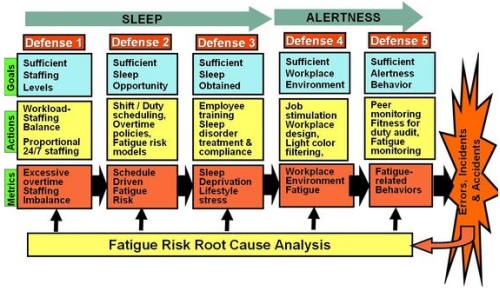
The five levels of risk and their defenses are summarized in the chart below:
Defense Level 1: Sufficient Staffing Levels
Ensuring a sufficient staffing level is an operation’s first line of defense. CIRCADIAN® offers tools that address taskload/workflow issues to ensure adequate staffing levels and proportionally balance them across the 24/7 schedule.
Risk Mitigation Tools:
Defense Level 2: Sufficient Sleep Opportunity
Even in appropriately staffed operations, employees risk becoming fatigued due to poorly designed shift or duty-rest scheduling that fails to account for commuting time, overtime, or employee shift-swapping. CIRCADIAN® works with operations to establish a strong line of defense against this risk level with the use of fatigue risk models and the setting of outer-boundary limits on work hours or days.
Risk Mitigation Tools:
- Shift Schedule Optimization
- Fatigue Risk Model Analysis of Duty-Rest and Shift Schedules
- Reserve Crew Policies and Shiftwork Overtime Policies
Defense Level 3: Sufficient Sleep Obtained
The third level of risk relates to the difficulty many employees have in getting enough sleep as they work a night or rotating shift. An inability to cope with a shiftwork lifestyle, an undiagnosed sleep disorder, and the intrusion of personal stressors such as caring for sick family members are just a few of the factors that lead to employee fatigue.
Risk Mitigation Tools:
Defense Level 4: Sufficient Workplace Environment
A workplace environment conducive to employees staying awake and alert through the nightshift is an essential line of defense in a successful FRMS. CIRCADIAN® assists operations in re-designing their workspaces to improve the intensity and wavelengths of lighting, sound levels, temperature, and humidity to ensure the safety of their employees who work at night.
Risk Mitigation Tools:
Defense Level 5: Sufficient Alertness Behavior
Having a workforce educated in recognizing the signs and symptoms of fatigue, as well as implementing a policy that clearly delineates actions steps to take if an employee becomes fatigue at work represents a strong fifth line of defense in an FRMS. In addition to providing training programs and education material, CIRCADIAN® offers alertness monitors, fitness for duty tests, and other tools to help reinforce this line of defense.
Risk Mitigation Tools:
- Behavioral check list
- Fitness for duty systems
- Controlled Rest Policies
FRMS As a Continuously Improving Tool: Fatigue Risk Root Cause Analysis
It is also vital to analyze employee errors, near-miss events, and accidents and incidents to establish a) if fatigue was a casual factor, and b) where specifically in the fatigue risk management chain the failure occurred and how it could be prevented in future
Risk Mitigation Tools:
- FACTS - expert web-based system that calculates the probability of whether a person was impaired by fatigue at the time of an accident or incident. Try FACTS for free.
- Gap Analysis of Your FRMS